The Miller
The Canterbury TalesThe Miller is one of the more vivid members of the pilgrimage company: a powerful working man whose bodily strength, loud entertainment, and rough appetite for obscene humor establish him as a comic and socially unmistakable presence. His portrait is brief, but its details are emphatic. He is less developed through inward conflict than through a concentrated public persona, and that persona makes him immediately legible within the company.
Identity and Introduction
The Miller appears among a compact group of travelers that includes the Reeve, the Summoner, the Pardoner, the Manciple, and the narrator. His place in this company identifies him as a tradesman rather than a courtly or clerical figure, and his introduction depends on physical presence and practical force. The narrator describes him as stout and exceptionally large in both muscle and bone, presenting strength as the first fact by which the other pilgrims would recognize him.
The Miller’s bodily power is not merely decorative. It serves him wherever he goes, suggesting that his trade and his public dealings are backed by a formidable physical authority. His portrait therefore joins labor, stature, and social effect: he is a working man whose body has become part of his reputation.
Appearance and Performance
The Miller carries a sword and buckler at his side, equipment that gives his robust figure a martial edge even though the evidence presents him primarily as a tradesman and entertainer. His face is rendered through striking, almost grotesque imagery: his nostrils are black and wide, while his mouth is described as great as a furnace. These details turn ordinary description into caricature, making the Miller appear heated, expansive, and difficult to overlook.
He is also a performer. He can tell jokes and stories, but their predominant subjects are sin and lechery. The combination of verbal entertainment and sexual coarseness places him firmly within the company’s comic register. His humor is not presented as refined wit; it is public, bodily, and deliberately provocative, matching the forcefulness of his appearance.
Music and Narrative Role
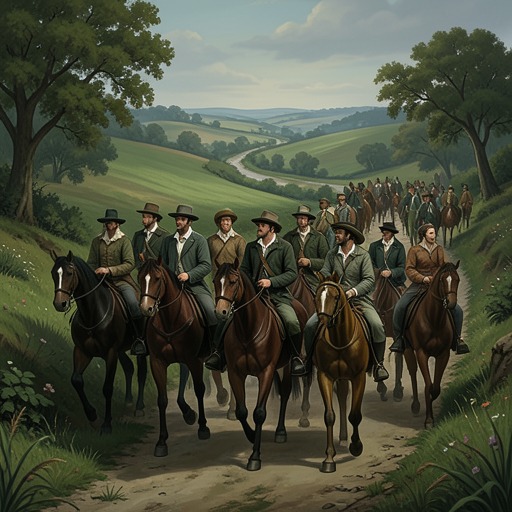
The Miller’s most distinctive act of performance is musical. He plays the bagpipe with confidence and uses it to lead the travelers out of town. The instrument gives his entrance and departure a processional quality: before the storytelling begins, the company is already accompanied by his noisy, unmistakable contribution.
This role makes him a natural agent of tonal disruption. The pilgrimage gathers people of different occupations and social positions, but the Miller’s bagpipe temporarily supplies a common rhythm, while his jokes and stories announce a less decorous kind of fellowship. He helps define the company not through authority or spiritual seriousness but through spectacle, sound, and irreverent amusement.
Characterization and Significance
The Miller is constructed as a strongly flat, instantly recognizable character. His principal traits are physical bulk, practical strength, a conspicuous face, obscene humor, and bagpipe playing; the narrative does not supply a private history or a later transformation that would complicate this public image. That concentration is purposeful. He functions as a sharply drawn social type whose appearance and behavior can be grasped at once.
His characterization also contributes to the work’s broad social range. Alongside officials, religious figures, legal professionals, and other travelers, he represents the energetic and unruly presence of manual labor and popular entertainment. His force is both literal and theatrical: he possesses the strength to make himself effective wherever he goes, and the music and stories to make himself heard. The result is a comic portrait whose few details carry considerable narrative weight, establishing the Miller as one of the pilgrimage company’s most memorable embodiments of bodily vigor and irreverent festivity.